Quitting Smoking and Its Relationship with Emotions, Anxiety, and Attention
On the third day of quitting, your hands are no longer shaking as much, and that hollow feeling in your chest has eased a little. But you discover something else that's worse: **your mind feels like it's wrapped in fog during meetings, a single word from a colleague can set you off, and at night you lie awake while your brain keeps replaying "just one cigarette and it'll be fine."**
Many people translate these experiences into one sentence: "I just have no willpower."
A more accurate translation is:
Your brain's reward system and prefrontal cortex are withdrawing from the "nicotine-contracted emotional and attention regulation" and relearning how to do their own work.
The withdrawal process will be noisy, shaky, and tiring — this is **recalibration**, not a character judgment.
This article explains three things as clearly as possible:
**Disclaimer:** This article is for health education purposes only and does not constitute medical diagnosis, prescription, or psychotherapy advice. If you experience persistent severe depression, panic attacks, suicidal thoughts, chest pain, significant heart rhythm abnormalities, or are pregnant/planning pregnancy or have significant chronic diseases, please promptly seek help from a licensed physician, mental health professional, or professional smoking cessation clinic.
I. Let's First Clarify the Experience: What You're Suffering From Is Often More Than Just "Wanting to Smoke"
The common "mind and mood" issues during smoking cessation are often mixed together:
| Experience Type | What Readers Often Say | A More Mechanism-Based Description |
| Mood swings | "I get annoyed at everything" | Unstable regulation baseline, lowered threshold |
| Anxiety | "My heart is hanging, can't sit still" | Hypervigilance, amplified bodily sensations |
| Reduced attention | "Can't focus on reading, keep zoning out" | Executive control and working memory temporarily strained |
| Blunted motivation | "Can't get excited about anything" | Temporarily reduced reward sensitivity |
| Cue craving | "Every meal/stress makes my hands itch" | Learning and memory have programmed "smoking" as a shortcut |
These experiences can occur individually, but more commonly they **amplify each other**:
Understanding the mechanism isn't about overwhelming you with terminology, but about changing your inner dialogue:
**It's not "I'm broken," it's "the system is reinstalling, the desktop is temporarily slow."**
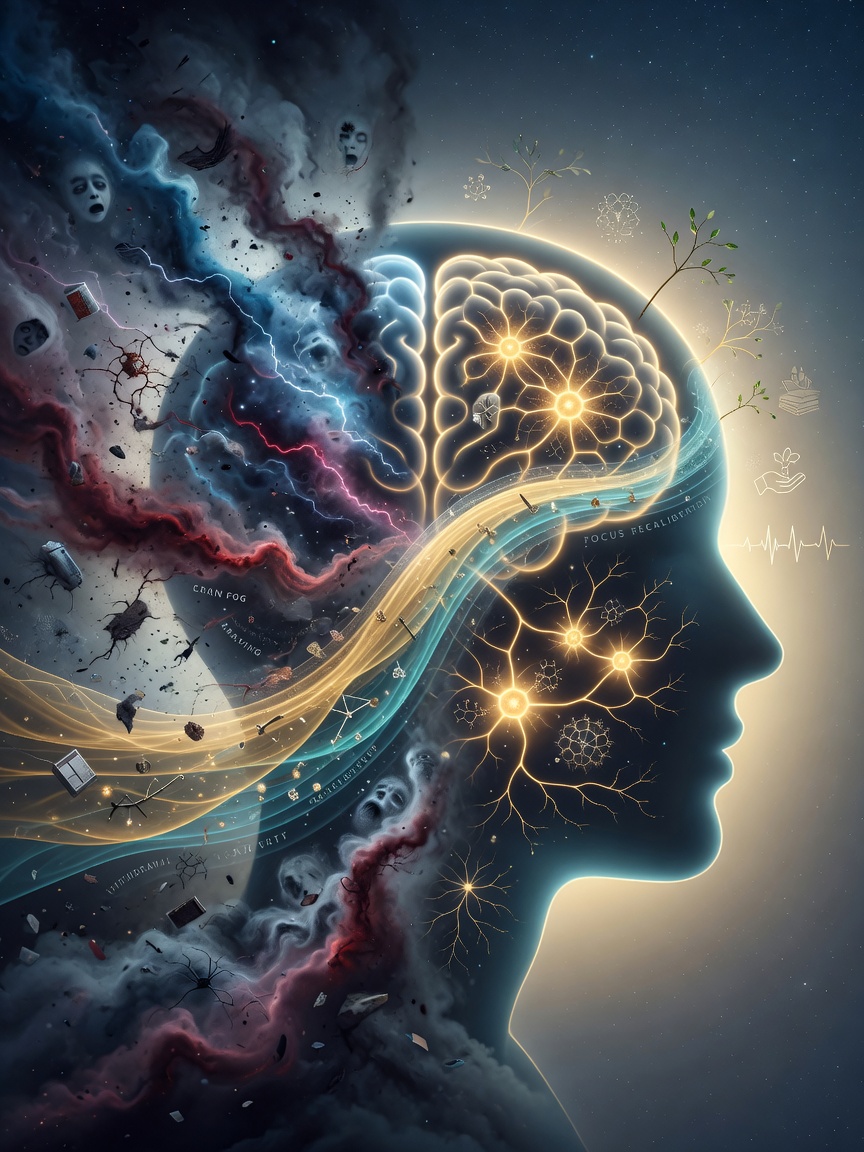
II. How Smoking "Rents" the Emotional and Attention System
1. Nicotine Is Not Simply a "Pick-Me-Up"
After entering the bloodstream, nicotine acts on **nicotinic acetylcholine receptors** in the central nervous system and engages multiple pathways related to reward, motivation, and learning — including **dopamine** (the mesolimbic pathway is commonly mentioned inpopular science).
Subjectively, many people describe smoking as providing:
Two important boundary points need emphasis:
2. The Prefrontal Cortex: Originally Meant to Be the "Master Controller"
The **prefrontal cortex** is roughly involved in:
The limbic system and craving-related networks are better at shouting: "I want it NOW!"
In healthy collaboration, the prefrontal cortex can say: "Wait, there are other ways."
After years of using smoking as an external emotional and attention aid, that collaboration gets rewritten:
3. Why "I Can Only Calm Down by Smoking" Becomes Increasingly True
Because the brain optimizes for efficiency: it doesn't care about your long-term health narrative; it cares about "what will reduce this discomfort fastest right now."
Thus a cycle forms:
↑ |
└────────── learning reinforcement: "do this next time" ←─────┘
Quitting is about actively breaking this cycle, letting the reward system and prefrontal cortex renegotiate: **Without nicotine, who regulates emotions? Who maintains attention?**
The negotiation period will be messy — the mess is the process, not the destination.
III. Withdrawal Period: What's Changing in the Reward System and Prefrontal Cortex
Below is apopular science-level framework describing **common patterns**, **not an fMRI report for every individual**. Individual differences are significant: daily smoking volume, inhalation depth, sleep, caffeine, baseline anxiety and depression, and social support all rewrite the timeline and intensity.
1. Reward System: From "External Power Supply" to "Temporarily Low Drive"
After long-term regular nicotine exposure, the nervous system develops **adaptation**. When you suddenly stop, common experiences include:
Think of it this way: there used to be a frequently pressed "quick reward channel" — when that channel closes, other rewards haven't had their volume adjusted yet, so the world appears temporarily a bit grayer.
**The good news:** This "grayness" gradually improves over weeks for many quitters; the brain retains plasticity, it just needs time andalternative experiences (the exhilaration after exercise, the clarity of good sleep, the sense of mastery from completing tasks) to "retune."
2. Prefrontal Cortex: Executive Control Temporarily More Energy-Intensive
During withdrawal, many people report:
| Function | Possible Subjective Feeling |
| Impulse control | Easier to be convinced by "just one" |
| Working memory | Just-read emails forgotten moments later |
| Sustained attention | Reading/meetings drift off more easily |
| Emotional regulation | Same stimulusmore easily triggers a strong reaction |
| Decision-making | More short-sighted, wanting immediate comfort |
This doesn't mean the prefrontal cortex is "broken." It's more like: when the reward and alert systems arenoisy, the master controller has to spend more resources to maintain order — **resources are being occupied by withdrawal**.
Therefore, demanding the same high-intensity output from yourself as usual during early quitting is often unfair and prone to failure. A more reasonable strategy is:
3. Anxiety and Emotions: Heightened Alert + Interpretation Bias
Withdrawal-related anxiety often mixes three sources:
Thus a typical phenomenon emerges:
**Naming the feeling** itself has a regulatory effect:
"This is withdrawal anxiety rolling in" is far more prefrontal-friendly than "I'm just a waste."
4. Timeline (Experiential Estimate, Not a Precise Medical Promise)
| Stage (varies by person) | Emotions / Anxiety | Attention / Executive Function | Common Focus |
| First 24–72 hours | Irritability, restlessness often prominent | Easily distracted, irritable | Ride out the waves, ensure safety and basic sleep |
| Approximately days 3–14 | Mood still fluctuating, anxiety prominent for some | Working memory and focus still unstable | Buildalternative regulation, avoid strategy mismatch |
| Several weeks later | Baseline often gradually stabilizes | Focus and motivation often improve | Cue cravings may persist, need stimulus control |
| Longer term | Emotional toolkit can be rebuilt for most | Attention function can continue recovering | Relapse prevention: stress events and "just one" excuses |
Remember: **your curve can be longer or shorter**. If severe depression, panic, or full functional collapse occurs, don't tough it out with a "popular science timeline" — seek professional evaluation.
IV. How Emotions, Anxiety, and Attention Interlock (and Where You Can Interrupt)
1. Vicious Cycle (Simplified)
→ Anxiety and irritability ↑
→ Attention hijacked by "cigarette" and "discomfort"
→ Task failure / relationship friction
→ Self-attack ("I'm like this")
→ Craving and relapse risk ↑
2. Interruption Points (Leverage Points You Can Actually Use)
| Interruption Point | What You Can Do | Mechanism (Plain Language) |
| A. Physical alarm | Breathing, walking, drinking water, cold water face wash | Lower physical arousal, give prefrontal cortex breathing room |
| B. Attention focus | Shift attention from "cigarette" to "next 2-minute action" | Reduce cue occupation of working memory |
| C. Interpretation style | "10-minute wave"alternative"it's over forever" | Reduce catastrophizing, lower secondary anxiety |
| D. Environment | Leave the balcony/smoking friends/visible smoking tools | Cut off the automated script's stage |
| E. Energy foundation | Sleep, blood sugar, caffeine management | Reduce "executive control power outages" |
You don't need to fix the entire chain at once. **Interrupt any single link, and the cycle weakens.**
V. Non-Smoking Methods: How to Regulate Emotions and Attention
Below is organized by "acute → daily → cognitive → medical support." The goal isn't "become a Zen master instantly," but **when the wave comes, make fewer worst decisions.**
1. Acute 5–15 Minutes: Survive This Wave First
Craving and anxiety peaks are often **episodic** — many people experience them as "waves" lasting minutes to about fifteen minutes — ride through the peak and the intensity often subsides on its own.
**Reproducible process (recommend saving to your phone memo):**
Key point: using alcohol to "suppress anxiety" orhigh doses of energy drinks to "force alertness" often backfires on sleep and heart palpitations later, making the next day worse.
2. Daily Baseline: Keep the Prefrontal Cortex Powered
Acute techniques are fire extinguishers; baseline management is rewiring the circuitry.
#### (1) Sleep: The Hidden Battlefield of Quitting
Insomnia and early waking directly undermine emotional stability and attention. Try:
#### (2) Caffeine and Blood Sugar
#### (3) Exercise: Serves Both Emotion and Attention
Moderate-intensity aerobic exercise (brisk walking, cycling, swimming, etc.) and strength training are commonly used in behavioral medicine as non-pharmacological means to improve mood and cognitivestate. No need to aim for a marathon:
#### (4) Attention Scaffolding (Specifically for "Brain Fog Meetings")
| Scenario | Scaffolding |
| Reading documents | Open only one document at a time; one-sentence note per paragraph |
| Meetings | Pen and paper: just note "three keywords + one action" |
| Deep work | 25–40 minute focus blocks + 5 minutes away from screen |
| Multitasking temptation | Phone airplane/focus mode; desktop shows only current task |
| Wheneasily triggered | Write important emails as drafts first, hit send 10 minutes later |
Early in quitting, allow yourself to **temporarily lower the difficulty**: completing a "scaled-down task" is more conducive to rebuilding a sense of control than pursuing perfect output.
#### (5) Social Interaction and Sunlight
3. Cognitive Strategies: Change the "Interpretation," Not Deny the Discomfort
#### (1) Distinguish Three Voices
| Voice | Example | How to Respond |
| Impulse | "I want to smoke right now" | "Having the impulse doesn't mean I have to act on it" |
| Command | "I must smoke or I'm done for" | "This is wave talk, set a 10-minute delay" |
| Value | "I want to sleep well, breathe easily, not be controlled by cigarettes" | "Choose the next small action based on values" |
#### (2) Self-Compassion vs. Self-Attack
Self-attack ("I'm irritable again, I'm such garbage") raises stress hormone-like experiences, making cravings stronger.
A more effective phrase:
"Anyone going through receptor and habit recalibration might feel irritable. What I need to do now is pick one small non-smoking action."
This isn't chicken soup — it's **reducing secondary harm**: the first layer is withdrawal discomfort, the second layer is shaming yourself — and the second layer can be turned off.
#### (3) "Ride the Peak" Expectation
Picture anxiety as a wave: it rises, peaks, and falls. Your job isn't to level the ocean — it's **don't throw away your surfboard** (delay, down-regulate, change environment).
4. Medical and Professional Support: When to Add External Help
popular science can't replace a doctor's advice, but you should know "there are also medications and counseling in the toolbox":
**Red flags suggesting prompt professional help:**
VI. Write "Regulation" as Your Personal Manual (Printable Checklist)
My High-Risk Triggers (Check 3–5)
Each Trigger, One Non-Smoking Action (Examples)
| Trigger | Alternative Action (Write What You'll Actually Do) |
| After meals | Brush teeth immediately + go out for a 5-minute walk |
| Stressful email | Stand up and get water first, take 6 deep breaths before replying |
| Zoning out in meetings | Note just three words; handle with Pomodoro after the meeting |
| Evening irritability | Hot bath/stretching, not the balcony |
| Drinking session | Get non-alcoholic drink in hand + one refusal phrase |
Daily Minimum Configuration (Especially Important in First Two Weeks)
Recording isn't about perfection — it's about seeing: **the waves have a pattern, and your tools are working.**
VII. Common Misconceptions Clarified
| Misconception | More Accurate Understanding |
| "If I feel anxious, it means quitting was wrong" | Anxiety is a common withdrawal and readjustment symptom, not a sign the path is wrong |
| "My attention is poor, one puff will fix it" | May provideshort-term alertness but reinforces "attention must depend on cigarettes" |
| "Willpower alone can suppress emotions" | Will is a resource, not an infinite mine; mechanism understanding + environment design save willpower |
| "Switching to e-cigarettes/heated tobacco solves emotional issues" | May change exposuremode but doesn't automatically rebuild emotional and attention self-regulation |
| "Rely on alcohol to sleep, rely on caffeine to power through" | Often borrows from the next day's emotional and attention bandwidth |
| "Others were fine after two weeks, I'm still struggling — I'm a failure" | Timeline varies enormously between individuals; what matters more than others is whether the trend and function are recovering |
| "Talking about brain mechanisms is just making excuses" | On the contrary: understanding mechanisms allows targeted strategies, not just self-criticism |
VIII. How to View This Together with "Psychological vs. Physical Dependence"
If you've also readpopular science about dependence types, here's how to combine them:
Emotions, anxiety, and attention issues are the dependence's **external interface** in the brain; dealing with them is dealing with quitting itself.
IX. Conclusion: Take the Button Back from the Cigarette Pack to the Prefrontal Cortex
Smoking once efficiently contracted three tasks: suppressing discomfort, switching states, and giving you a hand-script of "I'm doing something." Quitting isn't simply deleting a hobby — it asks your brain to:
This process can be uncomfortable, and it can also be very scientific:
**Delay, name it, down-regulate, change environment, sleep enough, move your body, break tasks down, seek professional help when needed.**
The first time you use a walk instead of a cigarette to get through those 10 minutes under stress, your reward system has already received one new data point:
"There are other buttons."
Buttons become more familiar the more you use them. The one on the cigarette pack will gradually become optional, not fate.
Reference Directions (For Further Verification)
*This article is intended for smoking cessation-related healthcognitive groundwork, emphasizing mechanism understanding and actionable alternatives, does not replace in-person medical consultation, and does not make efficacy claims for any specific product.*
Self-Attack Mode
"I'm irritable again, I'm useless" → stress hormones rise → cravings intensify
Self-Compassion Mode
"Anyone can feel irritable during withdrawal" → secondary harm reduced → easier to choose alternatives
* Withdrawal anxiety waves typically last about 10 minutes
* NRT stands for Nicotine Replacement Therapy